
Campbell River Community Foundation Launches Vital Signs 2026 Report at Collaborative Vital Breakfast
November 6, 2026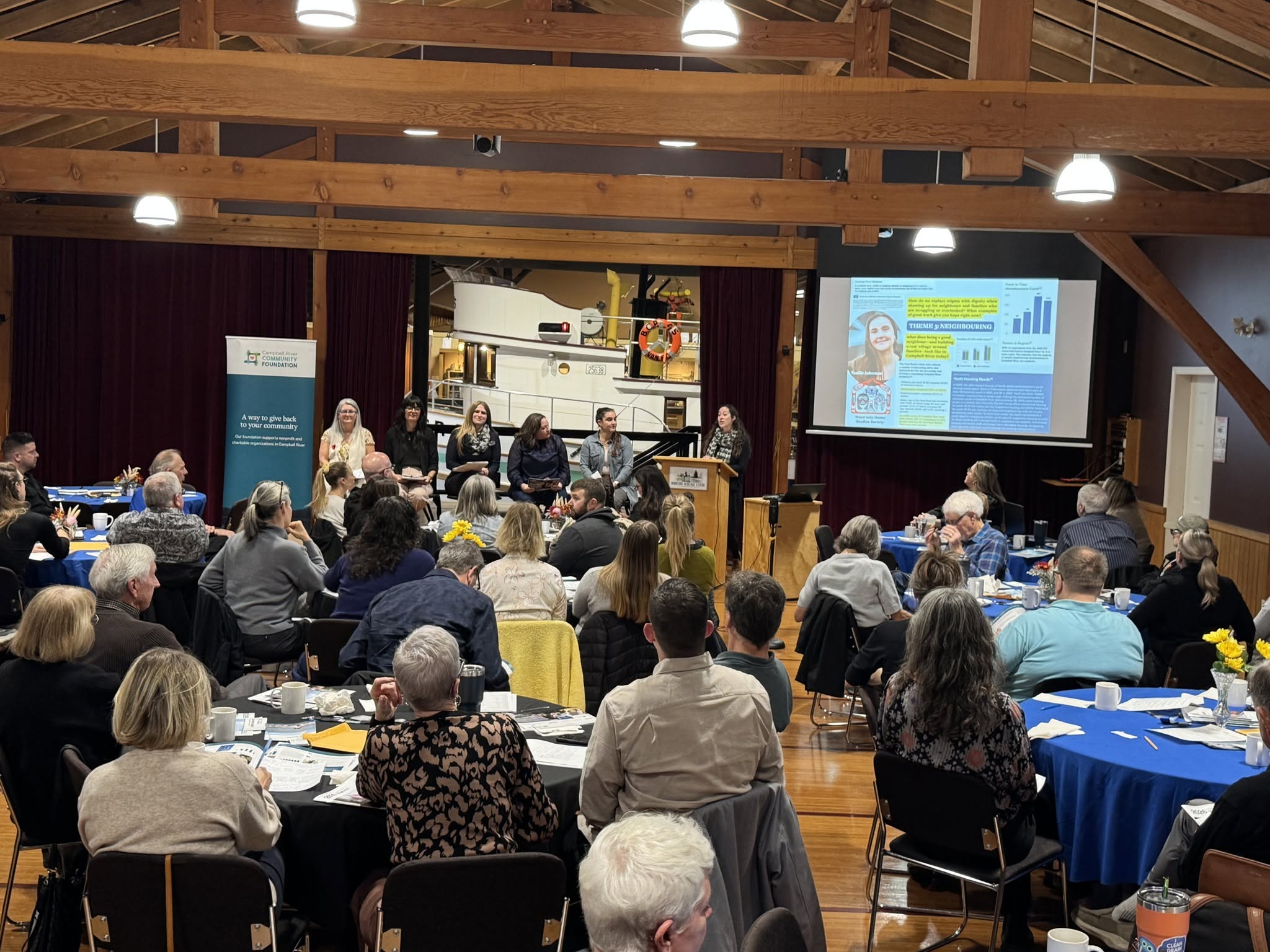
CAMPBELL RIVER, B.C. (November 4, 2026) — Local leaders, non-profit organizers, business innovators, and residents gathered this week for the official launch of the Campbell River Vital Signs 2026 report, an initiative of the Campbell River Community Foundation.
Held as a working breakfast, the event unveiled comprehensive local data tracking quality of life across Campbell River with a panel of community leaders. Moderated by Maggie Hodge Kwan, three key themes – getting started, innovation and partnerships, and neighbouring – were put forth to consider strength-based solutions to the region’s most pressing challenges.
Discussing the barriers and opportunities for youth and newcomers starting out in Campbell River, Shannon Baikie, Executive Director of the North Island Employment Foundations Society (NIEFS) emphasized the need for holistic community support. “Getting started, it’s not just about opening a door,” said Baikie. “It’s about truly being authentic and making sure that people feel supported, and that they can build their connections and opportunities through the doors that they walk through, and that they have a community that wants them to succeed. Employment, education, housing, transportation, mental wellness, and belonging don’t exist in isolation; they’re all connected.” From the report, we learned that 37% of newcomers who are employed are working in jobs that are below their skill and experience level. At the same time, youth high school completion rates are rising, but the local transition to post-secondary lags a little bit behind the province’s average, and locally we’re in a historic high for youth unemployment. When asked about barriers regarding local employers connecting with underemployed newcomers or youth talent, Baikie added, “Shifts in federal funding in terms of our international students have had a big impact on our college. It makes it difficult for folks to stay in the community and take the courses that they want – they may have to leave the community to access the education that they need. This has an impact on making sure we can be supportive of the industries that we have coming forward.”
Focusing on regional innovation, Naomi Tabata, Director of North Island College’s Centre for Applied Research, Technology and Innovation (CARTI), highlighted Campbell River’s growing marine bioeconomy and cross-sector potential. “The strengths in this community are tremendous,” Tabata stated. “How do we collectively harness all of that amazing energy, enthusiasm, talent, and skill, and turn that into innovation, which then turns into very strong, vibrant, healthy communities economically, socially, culturally? We do that, I think, through things like this: coming together to connect, whatever role you’re in.” Vital Signs published that 303 new business licenses were issued in 2025, and in that same year, nearly $3 million in Community Futures loans were granted, supporting more than 150 local jobs. At the same time, our traditional strengths, including our coastline, our forest, and Indigenous knowledge are driving new growth. Tabata shared, “We have tons of skills at North Island College, biologists, chemists, social scientists, archaeologists, or maybe our welders, mechanics, industrial automation, or robotics techs – and we love to make those available to the community. This is one of the ways that we can turn community innovation into regional strengths. At NIC, the blue economy is really one of the pieces that is a bright light for Vancouver Island and NIC has leaned in. We have training in marine sector opportunities, but on the research and innovation front, we have a team of researchers working with Nations, businesses, and community organizations up and down the coast. We are growing “baby seaweeds” – gametophytes – planting it, harvesting it, and processing in the lab. We make some food products, but we also are really interested in the agricultural space – bio stimulants, or as a building material – seaweed is a great base to make ceiling tiles, insulation, bio plastics. It grows in six months and is a quick turnaround and a wonderful opportunity to get incredible biomaterials in a short amount of time. NIC might be a place where you can come and we can support your business – if you have an idea, we’re happy to chat with you about how we can lend our expertise to your project.”
The panel also explored how financial and capacity pressures are sparking collaboration as a catalyst for innovation across the social profit sector. Campbell River has at least 296 registered non-profits and of the 30 who participated in the social-profit survey in June 2026, employ at least 1,063 people. 69% of these are governance boards, and 31% are working boards. Organizations are experiencing increased demand for more complex issues while needing to innovate to support staff retention through living wages and staff wellness in challenging environments. Campbell River Community Foundation Executive Director Michaela Arruda discussed the importance of activating the strengths of “the trifecta” – partnerships among the public, private, and non-profit sectors. “An example is the regional district partnering with the Hospital Foundation and Seymour Pacific Developments to build the Just Like Home Lodge. Government can enable through ownership of assets and the development of policy or bylaws, private developers can do what they do best which is develop and they can do it quickly, and non-profits are excellent stewards of and operators of assets that serve our community.” Arruda continued the importance of revenue diversification for non-profits, “Any businessperson knows that when you’re doing business, you don’t rely on just one stream of income. Why are we keeping non-profits dependent on grants? There is a common misconception that non-profits can’t make money, but when we generate mission-related revenue to reinvest back into the organization, we create stronger organizations. The stronger our organizations are, the stronger our people are, the more likely people are to show up at work, which helps business be successful, and therefore our economic ecosystem. It all goes around.”
Kirsten Soder, Managing Director of the Tidemark Theatre Society, expanded on this. “The Tidemark Theatre Society has participated in [Thriving Non-Profits] partnerships, and this has created a shared language in the non-profit sector around revenue: knowing what fee-for-service versus a grant versus impact funding. Non-profits tend to be resourceful – there’s something special about this part of the world, and I think it stems from this boom-and-bust cycle that we’ve lived with for a very long time, it just makes people resourceful, and it makes people want to help other people. There is a lot of discussion in our sector, particularly with the Arts Alliance, which forms and dissolves as certain issues come up that we need to address collectively. We can’t do it alone, and it doesn’t make sense to do it alone. And when you live in a city of this size, everyone knows a guy.” Soder continued, “Connection has been valuable at The Heart and through the Executive Director collaborative that the CRCF spearheaded, that has been a catalyst for cool new ideas. It’s about all of us pulling together in the same direction. There are a lot of non-profits in this town – we don’t need to start any new ones, if you want to get involved, you should get involved with one that already exists. We all have something to offer.”
Addressing the final theme of “neighbouring” we note that Campbell River’s population has grown to an estimated 43,897 (while the regional district is at 51,853), and 18% of this is youth, 53% is adults, and 28% is seniors. Throughout Vital Signs, there are stats related to neighbouring, population growth, demographics, and whether people are lonely, have someone they can rely on, or feel that they belong in the community. Some of the data challenges local stigmas about who is struggling. For example, the Strathcona Housing Alliance identified that 60% of Campbell River’s unhoused residents captured in the most recent point-in-time count have lived in Campbell River for five years or longer. Notably, approximately 90 local youth are experiencing homelessness or are couch surfing. From the Campbell River Food Bank we learn that a third of their clientele are children and youth, a quarter of their clientele are employed, 16% are seniors and over 10% are homeowners.
When asked how we replace stigma with dignity when we show up for our neighbours who are struggling or overlooked, Tanille Johnston, Founder of Mayaxala Home Studies Society highlighted the importance of dismantling biases through community connection. “Whenever I think about moving stigma to dignity, I think about education: you don’t know what you don’t know,” Johnston shared. “Biases aren’t necessarily bad- as long as you acknowledge them, know how they weigh into your decision making, and actively do something about that, that’s where you need to be. With the demolition of the Haida building, there was an assumption that everyone living there was a substance user or embedded in criminality and that’s just not true. There were seniors and people with varying abilities and disabilities living there and there was a big learning curve for many people who made assumptions about who lived within those walls.” Johnston elaborated on partnerships and innovation for neighbouring, “I just heard the Greenways tree gleaning program has an excess of apples and I don’t even eat pie but I know the Eagles auxiliary makes a lot of pie! There could be a partnership with fruit gleaning where the Eagles run a canning program and those could go to the food bank or get distributed in Hamper baskets. Partnerships that I’ve seen recently are things like the Art Gallery’s Art Hive program, bringing people from outside into welcoming spaces; our local boxing club that has partnered with the Laichwiltach Health Society to offer free boxing classes to Indigenous youth; the MOUHSS Bus locally brings together about eight different organizations providing healthcare and food security for folks struggling with housing. Getting into rooms with each other, more often than not, is what really helps us bridge gaps. Don’t start another non-profit, we have so many doing great things! Just ask somebody; they’re probably going to have your solution.”
The Campbell River Vital Signs 2026 report was made possible with support from Campbell River Daybreak Rotary, North Island College, NIEFS, and the Strathcona Regional District.
Digital copies of the complete report are now available to the public at crcfoundation.ca/vital-signs/, with physical copies available for pickup at The Campbell River Community Foundation’s office in the Ocean Pacific Building at Suite 302, 871 Island Highway.